Advanced Thermal Management for Thin 3D IC Using AlN and a 3D Heat Dissipation Network
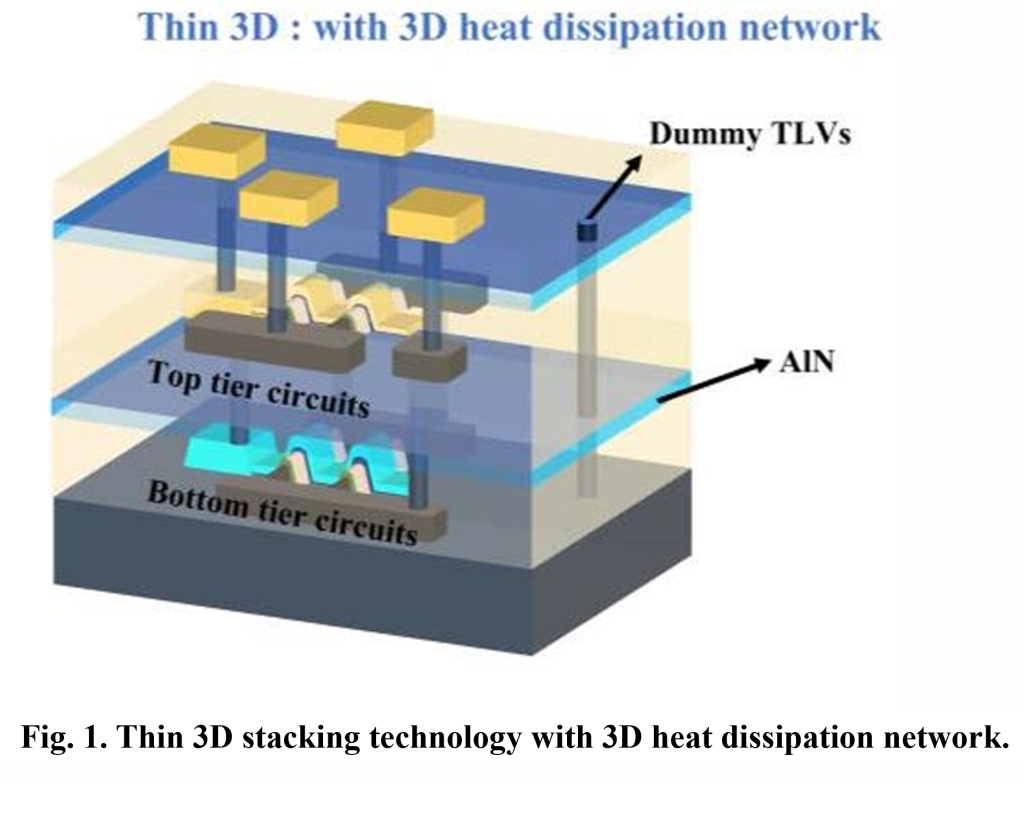
As Thin 3D IC technology reduces the interlayer thickness to the sub-micron regime, the achievable vertical integration density is significantly increased, while thermal management becomes an increasingly important challenge. Conventional low-thermal-conductivity dielectrics such as SiO₂ can restrict heat transport and cause heat accumulation around metal routing and active device regions. To address this issue, this work integrates an AlN heat-spreading layer with dummy through-layer vias (TLVs) into the Thin 3D IC stack, forming a three-dimensional thermal network that provides vertical heat-conduction paths from internal heat sources to the top-side cooling interface, as illustrated in Fig. 1.
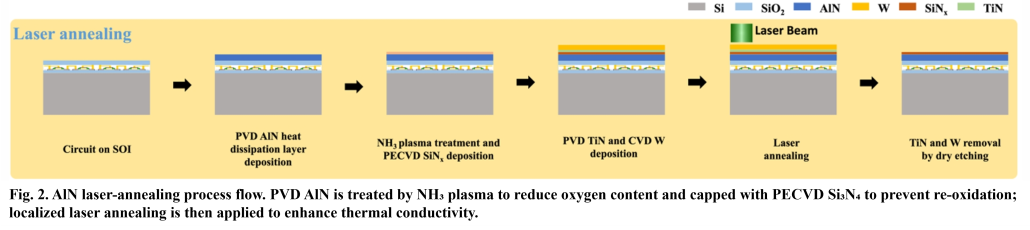
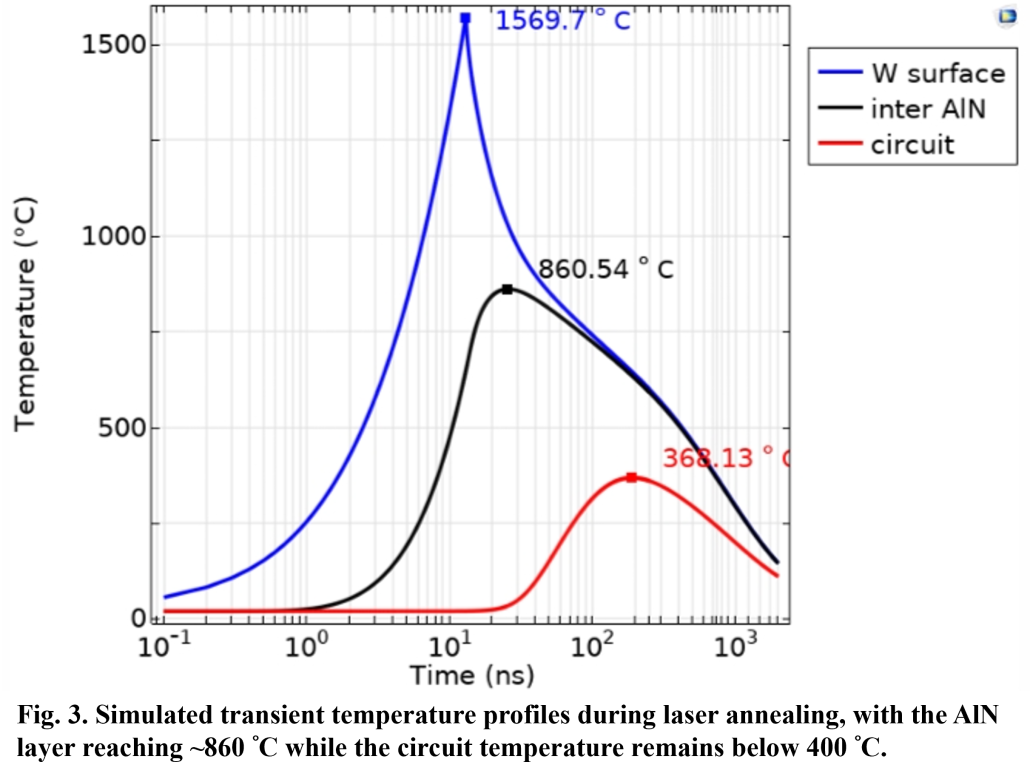
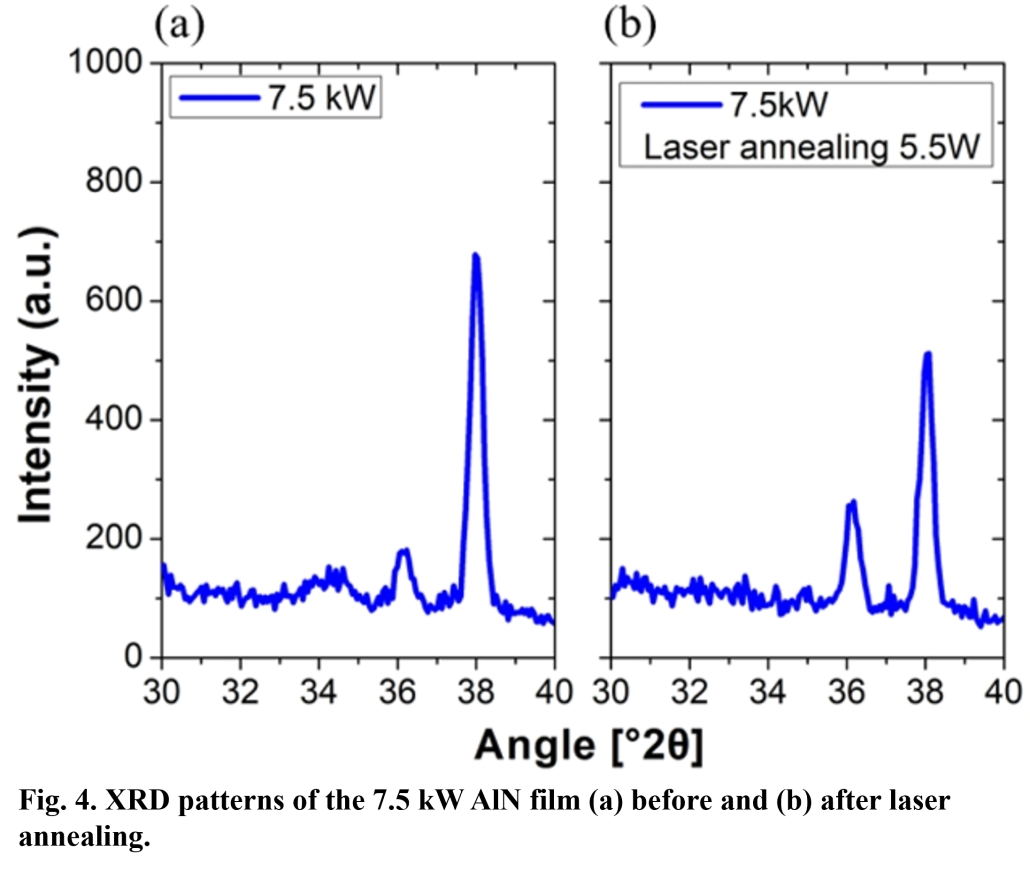
To enhance the cross-plane thermal performance of the ultra-thin AlN layer, the film properties are engineered through PVD deposition conditions and sputtering power, followed by NH₃ plasma treatment to suppress oxygen-related defects and an ultra-thin PECVD Si₃N₄ capping layer to prevent surface re-oxidation. Since AlN exhibits negligible absorption at 532 nm, a W layer is introduced as an optical absorber and thermal transducer for localized laser annealing, as shown in Fig. 2. Thermal simulation confirms that although the AlN layer locally reaches approximately 860°C during laser annealing, the underlying circuit remains below 400°C, maintaining the required thermal budget, as shown in Fig. 3. Following the plasma treatment and laser annealing processes, the AlN microstructure is further improved, achieving a cross-plane thermal conductivity of 45.5 W/m·K for the 7.5 kW AlN film. The corresponding structural evolution before and after laser annealing is shown in Fig. 4.
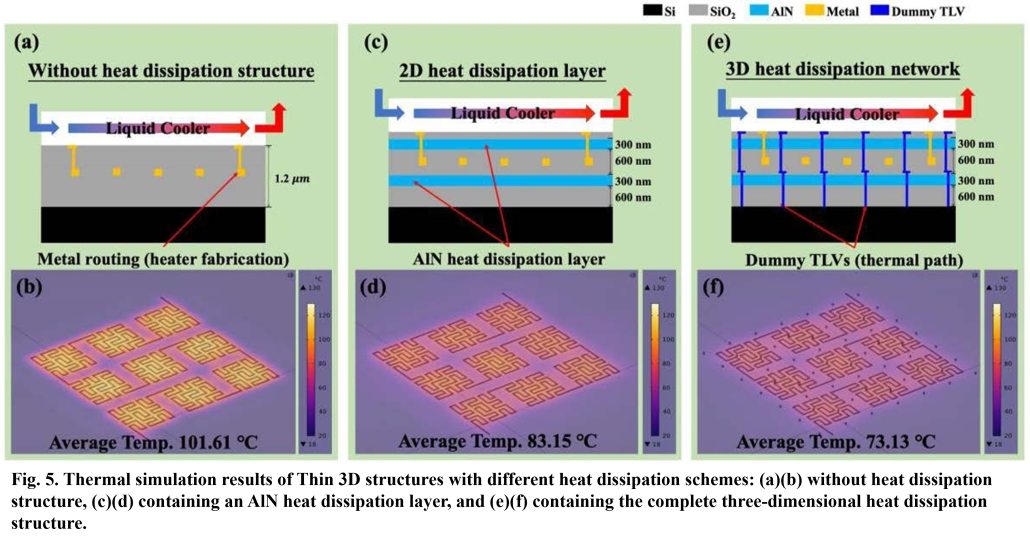
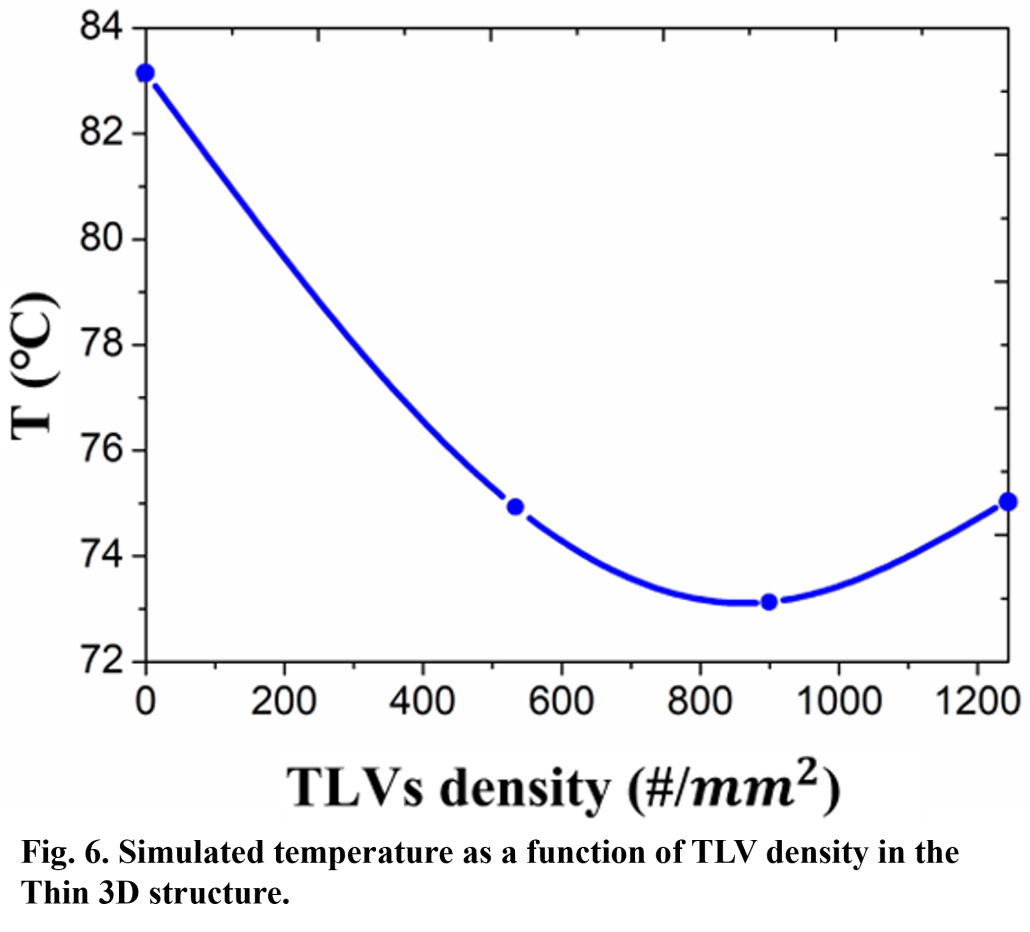
Beyond material engineering, dummy TLVs are introduced to establish dedicated three-dimensional vertical heat-conduction pathways, and COMSOL Multiphysics simulations are performed to evaluate the proposed thermal architectures. Without a dedicated heat dissipation structure, the average temperature reaches 101.61°C. The introduction of the AlN heat-spreading layer reduces the average temperature to 83.15°C, while the complete AlN and dummy-TLV-based 3D thermal network further reduces it to 73.13°C, as shown in Fig. 5. The effect of TLV density on the thermal performance is further investigated, with the corresponding optimization results presented in Fig. 6. By combining AlN material engineering with dedicated three-dimensional vertical thermal pathways, this work demonstrates an integrated thermal management approach for high-density Thin 3D ICs.
Figure
Related Technology